Kako Humid-Season Wardrobe Moisture Guide
Kako Humid-Season Wardrobe Moisture Guide
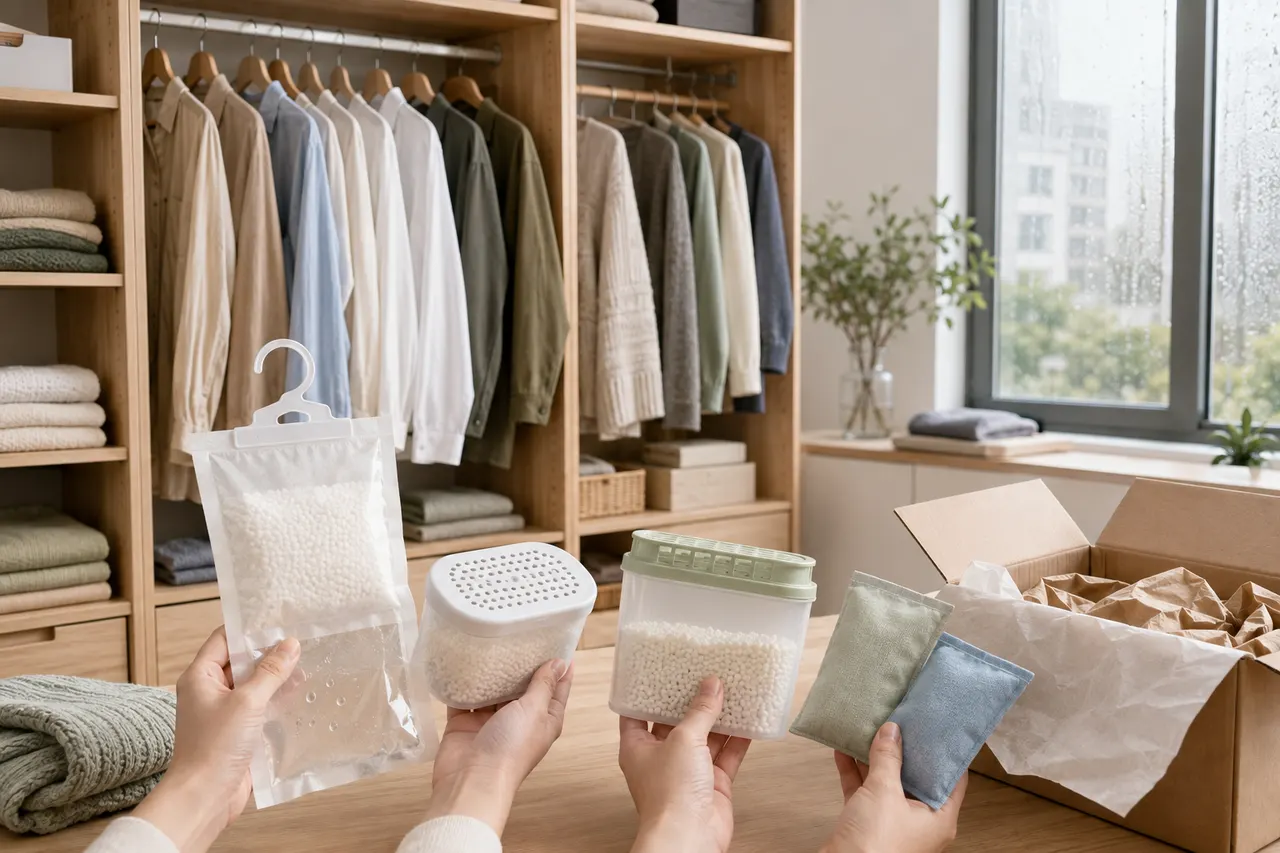
When the humid season hits southern China, high moisture in wardrobes can cause musty odors, mildew, or oxidation of metal fittings on clothes, shoes, and leather goods. The real problem isn't finding the "best moisture-proof product" in a vague sense, but rather filtering through the candidate products in the Kako Spreadsheet to find the right solution for your wardrobe space, clothing type, and maintenance habits, and filling in key information like capacity, specifications, and link status before placing an order.
This guide is for users who are organizing their wardrobe moisture-proof shopping list and are willing to regularly check the status of consumables. It is not suitable for situations involving wall seepage, already moldy cabinets, long-term severe indoor dampness, or the need for precise humidity control; these cases require addressing water sources, ventilation, and overall dehumidification first. This article does not provide unverified specific product prices, stock, or performance promises. Product pages and purchase conditions should be reconfirmed on the actual purchase day.
First Assess Wardrobe Space and Main Moisture Targets
Measure the wardrobe interior first, instead of ordering products by name. At minimum, record the cabinet's width, depth, height, as well as the number of shelves, drawers, and the height of the hanging area. Sealing is also important: an open wardrobe that is frequently opened and a cabinet that is kept closed for long periods require different placement strategies.
Divide the main moisture-prone items into three categories:
Hanging clothes: Focus on moisture around the shoulders, gaps between clothes, and the top of the cabinet.
Folded clothes: Focus on the back of shelves, the bottom, and areas with poor ventilation.
Shoes, bags, and leather goods: Need both moisture protection and prevention of desiccant leakage, tipping, or direct contact with materials.
If the wardrobe already shows visible condensation, persistent musty smell, or visible mold, clean it first and identify the moisture source. Moisture-absorbing products can only manage localized humidity; they cannot fix leaks, nor can they replace air conditioning dehumidification or a dehumidifier. 🌧️
Build Candidates in Kako Spreadsheet by Moisture Control Method
When using spreadsheetkako.com, treat it as a product discovery and organization entry point, not as the final specification source. Use the site's table categories, keywords, or existing fields to find candidates, then open the corresponding product page to verify information. Don't judge capacity and structure solely based on thumbnails or short names.
Use descriptive keywords like "wardrobe dehumidifier bag," "moisture absorber box," "reusable dehumidifier," and "shoe cabinet moisture protection," and record the following fields for candidates:
Product name and current link status
Product form
Nominal capacity or dimensions
Quantity per unit and per package
Whether refills, power, or regeneration are required
Whether the product showcases leak-proof, anti-tip, or hanging structure
Suitable wardrobe area
Unconfirmed information
Verification date
As of September 3, 2026, this article has not obtained page evidence to confirm specific candidate product prices, stock, sellers, materials, and shipping conditions, so it does not list specific product rankings. When actually purchasing, mark fields that cannot be confirmed from the current page as "to be verified," and do not infer based on similar products.
Compare Dehumidifier Bags, Moisture Absorber Boxes, and Reusable Products
The differences among the three types of products mainly lie in placement, maintenance frequency, and leakage risk, not in how professional the name sounds.
Product Form | Better Suited Location | Key Checkpoints | Common Limitations |
|---|---|---|---|
Hanging dehumidifier bag | Side of hanging area or gaps with clearance | Hook strength, collection area, full indicator, and leak-proof structure | Should not touch clothes; weight increases when full |
Moisture absorber box | Stable shelf, bottom of cabinet, or corner of shoe cabinet | Box dimensions, seal film, collection space, and anti-tip design | Needs to be placed flat; may not fit narrow shelves |
Reusable product | Areas where reducing disposable consumables is desired | Regeneration method, cycle conditions, status indicator, and usage limits | Needs periodic removal and handling; "reusable" does not mean permanently effective |
Don't just compare nominal capacity per unit. A more practical judgment is: can it be stably placed in the target location, is the status easy to observe, are consumables easy to replenish, and does the maintenance action fit your habits. Nominal moisture absorption is usually affected by temperature, humidity, and usage environment, and cannot be directly equated to a fixed number of usage days.
Arrange Placement for Hanging Clothes, Folded Clothes, and Shoes/Bags
For the hanging area, hanging-type products are preferable, but they should be kept away from sleeves, silk, wool, and leather to avoid squeezing the liquid collection area. Do not hang liquid-filled bags directly above valuable clothing.
For folded clothes areas, stable containers are better placed in corners of individual shelves, leaving space for observation and access. Do not bury moisture absorber boxes under clothes, nor block existing ventilation holes just to increase quantity.
For shoes and bags, first check if the container might be knocked over by shoe soles. Leather bags and shoes should not directly touch desiccants or liquid collection containers; items with metal fittings should also be kept away from possible liquid leaks. Small cabinets can use zone placement, but the number of products should be determined by space and actual humidity, not mechanically "one per shelf." 👚👟
Verify Capacity, Refill Method, and Anti-Tip Structure
After opening a candidate product page, check item by item whether the name, specification images, and text description are consistent. Capacity fields are especially confusing: packaging may show net weight of moisture-absorbing material, liquid collection capacity, unit count, and package count simultaneously. If any number lacks a unit, do not write it directly into your purchase list.
Refill methods can be categorized as whole-unit replacement, replacement refill pack, or removal for regeneration. Consider the following before choosing:
Whether compatible refills are consistently available locally
Whether replacement requires contact with liquid or granules
Whether regeneration requires plugging in, heating, or ventilation
Whether product status can be judged without opening the package
Whether it can be safely removed when full or expired
Anti-tip cannot be judged solely by a "box" appearance. Check whether the bottom is flat, the center of gravity is stable, the sealing structure is clear, and whether the product description indicates the correct opening direction. If the page does not show key structures, list it as an information gap rather than assuming safety. 🧴
Use a Checklist to Review Links, Specifications, and Information Gaps
Before submitting an order, perform a purchase verification for each candidate:
The link is still accessible and opens the specific product page, not a blank page, tag page, or invalid redirect.
The page has a clear product name that matches the candidate in your table.
Specifications, package quantity, dimensions, and units are legible.
Refill or regeneration method is clearly explained.
Hanging, flat placement, or other installation conditions match the target location.
Current price, stock, seller, and delivery conditions are confirmed on the purchase day.
Restrictions regarding children, pets, clothing materials, or electrical environments have been checked.
Unconfirmable fields remain as "to be verified," without filling in guesses.
If multiple candidates only show the same promotional slogans without dimensions, structure, or maintenance information, they cannot form an effective comparison. In that case, reduce the number of candidates rather than filling the list with items lacking evidence. ✅
Plan Inspection and Replacement Frequency During Humid Season
Do not assume all products can last a fixed number of days. Establishing a simple inspection rhythm is more reliable: observe more frequently after initial placement to gauge the rate of moisture accumulation in the cabinet; then adjust intervals based on liquid amount, status indicators, musty odor, and weather changes.
Each inspection can record the date, product location, remaining status, whether liquid is present, whether there is leakage, whether clothes have a musty smell, and whether replacement is needed. During continuous rain, if the wardrobe is against an exterior wall, the door is closed for long periods, or not fully dry clothes are put in, check earlier.
When replacing products, don't just swap the consumable; also dry the placement area and check surrounding clothes. If the same location repeatedly fills with liquid quickly, consider using room-level dehumidification equipment, improving air circulation, or checking the wall, rather than endlessly adding more absorber boxes.
Exclude Inapplicable Options and Finalize Purchase List
The final list does not need to keep every product that seems relevant. Exclude candidates under the following circumstances:
Dimensions cannot be confirmed and may block the cabinet door or squeeze clothes.
The liquid collection container cannot be placed stably.
Refill method is unclear, or the required consumables' compatibility cannot be confirmed.
Page link is invalid, and price, stock, or specifications cannot be verified on the purchase day.
The product's regeneration conditions are not suitable for a home environment.
The product description and images clearly conflict regarding package quantity or structure.
The purchase list should be recorded in the format of "location + product form + quantity + items to verify," for example: "Hanging area side, hanging type, quantity to be determined based on cabinet width, check full weight and leak-proof structure." This notation is more reusable after page updates or candidate replacements than directly copying product titles.
A proper moisture-proof plan can reduce losses from clothes re-dampening and frequent cleaning, but it increases consumable costs, inspection work, and liquid leakage risks. It is suitable for households where the wardrobe experiences seasonal humidity and users can regularly inspect and replace products; it is not recommended for cabinets with water seepage, severe mold, prolonged absence of inspection, or as a whole-house humidity management solution using localized moisture absorbers. Before completing the purchase, verify links, specifications, refill methods, and placement safety once more to truly turn candidates from the Kako Spreadsheet into an actionable list.
Agent Platform Shopping FAQ
1. In what way can I examine the quality-control images on spreadsheetkako.com?
When you look over QC photos, it's important to concentrate on the particular details of the item you bought. Take shoes as an example: you should inspect several crucial spots—like the toe area, heel, and tongue—to evaluate the stitching, the overall shape, and the tongue's thickness so you can determine if it's a well-made pair. For garments, pay attention to the collar label, logo embroidery, material, and how smooth the collar and cuffs are, among other aspects.
2. What is the best way to look for a product I want on spreadsheetkako.com?
You can either use a single search term or head straight to the category section, which also sorts items by brand. Generally, longer phrases yield fewer results than shorter ones, though they tend to be more targeted. As an illustration, try searching for "Air Force 1 White," "sneakers," or just "Air Force 1."
3. Which kinds of products are available on spreadsheetkako.com?
The site provides a wide array of categories, covering shoes, T-shirts, sweaters, hoodies, jeans, sweatpants, shorts, beach shorts, factory clearance deals, down jackets, baseball jerseys, shirts, hats, jewelry, bags, electronics, sunglasses, socks, underwear, and trending collectibles.
4. For what reason should I rely on the spreadsheet offered by spreadsheetkako.com?
Since agent platforms typically don't show products directly, you need a spreadsheet to browse for items you're interested in and locate their buying links. Another option is to ask for suggestions on Reddit or Discord—the products shared there are usually great, but the process can be slow. These spreadsheets are generally built over a long time by collecting information from those communities.
5. What's the drawback of using Google Sheets for this purpose on spreadsheetkako.com?
Google Sheets works fine only when the spreadsheet contains a small number of products. As the item count grows, loading time becomes very slow and the interface gets laggy. This is particularly true on mobile devices, where the layout looks poor and searching for products is quite inconvenient. For the same catalog, the spreadsheet on this website loads faster and delivers a better visual experience.
Browse our latest products and find your next favorite item.